
"We hope that India will proceed from the overall interest of our bilateral relations and honour its commitment," Chinese Foreign Ministry spokesman Qin Gang told a regular news briefing when asked if Beijing was satisfied with the Indian government's handling of protests by Tibetans. Qin said no country in the world had recognised Tibet as an independent country and, since ancient times, it had been an inalienable part of China.

The 7.9 Richter Scale temblor that struck Nepal on Saturday also affected parts of Tibet. The two border ports to Nepal were seriously affected.
The Chinese government has ordered security forces in Tibet to crush any signs of support for the Dalai Lama, as the 50th anniversary of the Tibetan spiritual leader's escape to India draws near.
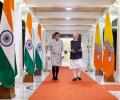
Although the special relationship might compel Bhutan to be considerate of Indian interests, new challenges will likely arise. An emerging new phase of relations will also call for fresh redlines between India and Bhutan, observe Harsh V Pant and Aditya Gowdara Shivamurthy.
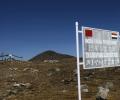
India has been rejecting China renaming places in Arunachal Pradesh, asserting that the state is an integral part of the country and assigning "invented" names does not alter this reality.
No fresh outbreak of violence was reported by authorities in Lhasa, which came under the vice-like grip of security forces after Friday's orgy of violence saw marauding mobs torching buildings and police and private vehicles, and loot banks and shops. However, spontaneous demonstrations continued elsewhere in China with at least three Tibetan protesters killed in clashes in a Tibetan-populated district of Sichuan province in southwest China, rights groups said.

How does blatantly claiming Indian territory help to maintain 'peace in border regions', is a mystery that only China can explain, notes Claude Arpi.

'India should today tell China to provide proper facilities in Minsar for Indian yatris visiting Mt Kailash,' says Claude Arpi.

India's External Affairs Minister S Jaishankar has stated that the US administration under President Donald Trump is moving towards multipolarity, which aligns with India's interests. He also revealed that India and the US have reached an agreement on the need for a bilateral trade pact. Jaishankar touched upon various foreign policy issues including India's role in the Russia-Ukraine conflict, the trajectory of the BRICS grouping, and relations with China during a session at the Chatham House think-tank in London.

The seventh Tibet Work Forum was held in Beijing on August 28 and 29. Delhi should be deeply concerned, at a time India faces a precarious situation in Ladakh, because the TWF also defines China's western border policies, observes Claude Arpi.
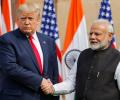
The China threat continues to resonate in the strategic partnership between India and the USA, points out Rup Narayan Das.

Eight Nobel peace prize winners, including Archbishop Desmond Tutu of South Africa, on Tuesday asked China to end its 'repressive' policies in Tibet and expressed their support to Tibetan spiritual leader Dalai Lama's efforts to achieve autonomy for his homeland. The support by Nobel laureates -- Jody Williams, Shirin Ebadi, Mairead Corrigan Maguire, Desmond Tutu, Rogoberta Menchu Tum, Adolfo Perez Equivel, Betty Williams and Wangari Maatai -- was contained in a signed letter
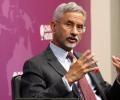
"From President Trump's perspective, the one big shared enterprise that we have is the Quad, which is an understanding where everybody pays their fair share. There are no free riders involved. So that's a good model which works," he said. The Quad alliance consists of the US, India, Australia and Japan.

Dai Bingguo, who served as the China's boundary negotiator with India from 2003 to 2013, told Chinese media, "If the Indian side takes care of China's concerns in the eastern sector of their border, the Chinese side will respond accordingly and address India's concerns elsewhere."

China on Thursday sharply criticised US special coordinator for Tibetan issues Uzra Zeya's meeting with the Dalai Lama and her visit to Dharamshala, saying it violated Washington's commitment that Tibet is part of China and it does not support Tibetan separatists.

Lieutenant General Shakti Gurung deserves to be complimented in telling his life story and that of his people, as subaltern communities within this vast and diverse nation of ours clamour for recognition and a plea for their voices to be heard and their aspirations to be met, notes Lieutenant General Gautam Moorthy.
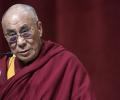
US Special Coordinator for Tibetan issues Uzra Zeya will travel to India and Nepal this week to deepen cooperation on human rights and democratic governance goals with the two nations, the state department has announced.

'Information about the Dalai Lama's heath is normally not shared with the public. Its release on this occasion implicitly underscores the message that the window of opportunity for Beijing to recommence the dialogue with the Dalai Lama -- an advocate of non-violence -- to resolve the contentious Tibetan issue is limited.' says Jayadeva Ranade.

Chinese foreign ministry spokesman Zhao Lijian told a media briefing that "the Indian side should fully recognise the anti-China separatist nature of the 14th Dalai Lama."

Samdong Rimpoche's visit to China materialised against the backdrop of strained India-China relations consequent to the face-off between Indian and Chinese troops at Doklam, says former RAW officer Jayadeva Ranade.

Holding banners and raising anti-China slogans, protesters carried out a peaceful demonstration amid heavy personnel deployment, the police said.

'We are developing infrastructure on the mountains and deploying the troops on hill borders in such a way that it is ensuring the safety of the people there.'
Taking serious note of protests by Tibetans in India during the visit of President Hu Jintao, China on Thursday said Tibet was an "integral part" of its territory and the region's affairs were an "internal matter".
"We accept India as a land of Buddha," he said, adding that he had no regret for not getting an opportunity to return to Tibet.

China plans to build a new highway along the Line of Actual Control (LAC) with India as part of Beijing's efforts to strengthen its strategic position and project its power, a media report said on Wednesday.

Since Tibet's occupation, China has disrupted the natural flow of rivers by pursuing a series of ill-conceived environmental and developmental policies such as the Great Leap Forward, the South-North Water Diversion Project, etc, the report said, adding that, this has led to a dam-building spree on the Tibetan plateau with disastrous impacts on Asia's major rivers.
In Tibet, the people's frustration with their colonial masters has reached the extreme, international silence is too loud, says Vijay Kranti
Self-immolation by six Tibetans, including three teenage monks, protesting Chinese rule in Tibet continued to haunt China as Communist Party leaders on Thursday began a key meeting where Panchen Lama, projected by Beijing as the rival to the Dalai Lama, was given prominence.
Rebuffing the Dalai Lama's remarks that there were "encouraging signs" about China changing its attitude towards Tibet, a top Chinese official has said there would be no breakthrough in talks until the Tibetan spiritual leader changed his stand on "some fundamental issues".
Accusing China of creating "hell on earth" in Tibet by launching a "brutal crackdown," Tibetan spiritual leader, the Dalai Lama on Tuesday demanded "legitimate and meaningful" autonomy for the Himalayan plateau.
India and the United States on Monday urged China and the Dalai Lama to hold peaceful negotiations between them to resolve the pro-independence unrest in Tibet with Washington insisting that dialogue was the "only" policy that is sustainable in the Himalayan region.

China is training Buddhist monks and nuns in Tibet to carry out anti-espionage operations along the remote Sino-Indian border.
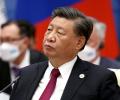
Xi Jinping's recent actions in South Asia have amply demonstrated the disastrous impact of China's embrace, observes Jayadeva Ranade, the retired senior RA&W officer and China expert.

The earthquake damaged houses, roads, as well as other infrastructures, state-run Xinhua news agency quoted eyewitnesses from the area as saying.

Nearly two decades ago, then defence minister George Fernandes said: 'China has built roads up to the border, while there has been negligence on India's part.' Since Fernandes uttered these brave words, what has been done on the Indian side? The Modi Sarkar is apparently trying, but little has been achieved so far, says Claude Arpi.
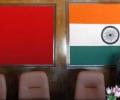
India on Friday strongly protested China's decision to issue invalid visas to some of its athletes for the Asian Games.

India on Tuesday lodged a strong protest with China over its so called 'standard map' laying claim over Arunachal Pradesh and the Aksai Chin, and asserted that such steps only complicate the resolution of the boundary question.

Joshi's reaction came after Gandhi termed as "very serious" the issue of China releasing a "standard map" that laid claim over Arunachal Pradesh and Aksai Chin, and claimed the neighbouring country has already taken India's land in Ladakh and Prime Minister Narendra Modi should speak on the issue.
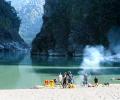
Arunachal Pradesh Chief Minister Pema Khandu on Wednesday expressed concern over China's proposed mega hydropower project on the upstream of Siang River in Tibet, stating it will have a cascading effect on India and Bangladesh in the near future.
